
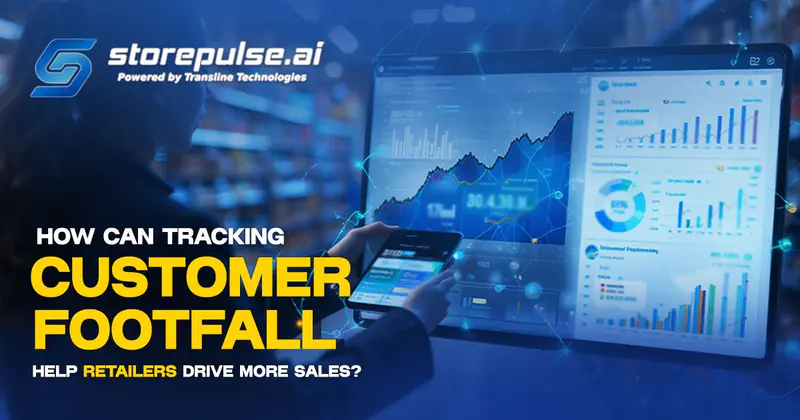
Most of the time, when customers walk into a retail store, they browse, wander around, and leave without buying anything and retailers often do not know why. It is not always about having banger products; it is about creating the right experience for your customers. Naturally, customers are more likely to buy when they find it easy to navigate the store and quickly locate what they are looking for.
Retailers may bring in the best products based on market trends, yet still fail to understand why customers do not buy even when the store is stocked with trendy items. The missing link here is customer tracking.
Customer tracking is all about gaining knowledge of how many customers enter your store, in other words retail store footfall or customer count. It also helps retailers understand which sections customers explore the most, which areas they spend the most time in, and which zones are popular versus which ones need improvement. This insight gives retailers a clear idea of how customers actually behave inside the store.
Based on retail store footfall data, retailers can create a customised store layout optimised for customer needs. Customer tracking is not just about having customer count details in hand; in the bigger picture, it becomes a powerful force for driving footfall to stores.
In this blog, you will understand exactly how.
What Is Tracking Customer Footfall in Retail?
Customer footfall tracking is a method used by businesses to understand store footfall and customer behaviour using AI driven CCTV, webcams, AI footfall tracking systems, and an automatic footfall counter for retail. These technologies help retailers optimise store layout optimisation, staff productivity, marketing, sales, and more.
At present, with advancements in technology and new developments in artificial intelligence, several footfall counter for retail solutions are available. Most of these systems work through AI that tracks customer movement within the store. This footfall traffic counter provides accurate entry and exit counts, repeat visitor data, and retail dwell time, helping retailers gain deeper insights into how customers interact with the space.
While manual counting is time consuming and laborious, AI footfall tracking and customer counting through an automatic footfall counter for retail like StorePulse AI is seamless, efficient, fast, and reliable. Having a thorough view of retail store footfall helps retailers understand what type of customers visit their store.
With the help of retail people counting software, retailers can identify which age group visits the store more frequently and which gender is more attracted to the store. These insights allow businesses to make data driven decisions that improve customer experience and overall store performance.
Understanding Customer Footfall vs Actual Conversions
Most retailers confuse high customer traffic with high sales. Having high retail customer footfall does not guarantee high sales. Simply knowing your footfall count does not mean customers will make purchases. For example, you may receive 500 visitors in a day but only 50 purchases. In that case, the number 500 does not matter as much as the 50 purchases.
Now consider a competitor who also gets 500 visitors but converts 100 of them into buyers. Naturally, you would want to know why. Is it because they have better products? Not necessarily. You may both offer the same quality, but the difference lies in their understanding of retail conversion analysis.
This is where retail analytics becomes a powerful tool for retailers. It is not only about measuring footfall count. When footfall data is combined with POS data, it delivers highly actionable insights that can truly transform retail performance.
With detailed footfall analytics such as retail dwell time analysis, busiest hours, busiest days, customer demographics, staff productivity, layout optimisation, and zone wise traffic patterns, retailers gain a completely different level of visibility. These insights help businesses understand not just how many customers enter the store, but why some convert and others do not, enabling smarter decisions that directly impact sales.
Why Tracking Customer Footfall Matters for Retail Sales
Customer tracking has become a core tool in retail analytics. Tracking customer footfall matters in more ways than one can imagine. It not only improves how retail sales optimisation is studied and adopted, but also helps retailers truly understand customer intent. Customer tracking aids in identifying the reasons behind sales drops, allowing retailers to work on those gaps effectively. By providing analytics on which days perform best and which time slots see higher activity, retail owners can plan staff schedules more efficiently and run in store promotions during high impact hours.
Retailers can also experiment with different store layout designs and then use customer footfall counter software to evaluate which layout performs best. Similarly, multiple experiments can be conducted to identify what works best for the store, based on real customer behaviour.Overall, customer tracking helps reduce mental guesswork and enables retailers to plan better using data driven insights rather than assumptions.
How Retailers Track Customer Footfall Today
There are several footfall counting methods available today. For a large part of history, footfall counting was done manually, requiring long hours of effort and often leading to human error and inaccuracies. With the advancement of artificial intelligence, retailers can now achieve greater accuracy while saving time and effort.
Technologies such as infrared sensors, thermal cameras, video based people counting, CCTV systems, and footfall counter for retail software allow retailers to track customers and analyse customer footfall traffic more effectively. A basic footfall traffic counter can provide visitor footfall counts, but a smart analytical tool goes much further. Advanced systems not only deliver accurate counts but also provide visitor demographics, busiest hours, peak hours, retail dwell time, zone wise dwell time, snapshot per minute insights, and more. Most automatic footfall counters use AI powered CCTV systems to deliver scalable, accurate, and real time analytics that help retailers make informed decisions.
Identifying Peak Hours, Dead Zones, and High-Engagement Areas
Customer footfall tracking is not enough on its own. One needs to identify peak footfall hours to truly understand store performance. Peak footfall hours are the time periods when the highest customer traffic enters the store, allowing retailers to plan and operate more efficiently during those hours. Every store has dead zones, areas where there is little to almost no customer traffic. At the same time, there are high dwell time zones, where customers spend the most time. Identifying these high engagement zones helps retailers understand which products, aisles, and sections are in high demand.
Retailers can experiment by placing less in demand products in these high visibility zones to increase their exposure and improve sales. This approach not only enhances product placement strategies but also supports better store layout optimisation. Overall, insights from customer footfall tracking help retailers make smarter decisions around space utilisation, product placement, and customer experience.
Using Footfall Data to Improve Staff Deployment
Efficient staff management can significantly impact retail performance. One of the major concerns for retailers is whether their store is understaffed or overstaffed at any given time. Smart shift planning helps address this challenge and improves overall efficiency. Manpower is rarely the issue; efficiency is the key. By allocating staff based on peak hours, retailers can ensure better coverage when customer traffic is highest. This becomes much easier with the help of customer tracking, which provides clear insights into traffic patterns throughout the day.
Proper staff allocation leads to shorter queues, improved customer service, and lower operational costs. Ultimately, the effectiveness of staff management depends on how well retailers analyse their retail analytics and how they translate those insights into action.
Turning Customer Footfall Data into Actionable Sales Insights
Collecting customer footfall data is only the first step. Data on its own does not create impact unless it is analysed, interpreted, and translated into action. Retailers often have access to large volumes of store traffic data, but without the right tools and context, this information remains underutilised. The real value lies in converting raw numbers into data-driven retail decisions that directly influence sales performance and customer experience.
When footfall insights are applied correctly, retailers can make meaningful operational changes. Store layouts can be redesigned based on actual movement patterns rather than assumptions, ensuring high-visibility areas are used effectively. Promotions can be timed to align with peak traffic periods, maximising exposure and engagement. Staff schedules can be adjusted to match customer flow, improving service quality during busy hours while reducing unnecessary operational costs during slower periods. These decisions not only improve efficiency but also play a key role in driving footfall to stores and increasing conversion potential.
Footfall Analytics Impact on Store Layout and Visual Merchandising
Store layout plays a critical role in how customers move, browse, and engage within a retail space. The way aisles are designed, products are positioned, and signage is placed directly influences customer flow and overall store design performance. A well-planned layout encourages smooth movement, while a poorly designed one can create congestion, confusion, or overlooked sections within the store. Product placement, aisle width, and clear signage are key elements of effective visual merchandising. Wide, accessible aisles invite customers to explore more comfortably, while strategic product placement ensures high-visibility for important or promotional items. Signage helps guide customers through the store, drawing attention to offers, categories, or new arrivals, and reducing friction in the shopping journey.
With the help of visual merchandising analytics, retailers can test and measure how different layouts perform in real-world conditions. By analysing customer footfall patterns, retailers can see which layouts attract more movement, increase retail dwell time, and improve engagement across different sections. This data-driven approach removes guesswork and supports better store layout optimisation. Ultimately, footfall data validates design decisions, helping retailers create layouts that not only look good but also drive higher engagement and sales.

The Role of AI and Video Analytics in Footfall Tracking
AI has changed the way retailers understand customer movement inside stores. AI footfall tracking works by using intelligent cameras and software to automatically detect, count, and analyse customer movement in real time. Instead of relying on manual counting or basic sensors, AI observes how customers actually interact with the retail space. What AI enables goes far beyond simple counting. Retailers get real time insights into store activity, including live customer count, peak hours, and movement patterns. With the help of heatmaps, retailers can visually see which areas of the store attract the most attention and which zones are ignored. AI also makes repeat visitor analysis possible, helping retailers understand customer loyalty and engagement over time.
Video analytics for retail adds another layer of intelligence. It helps retailers analyse customer behaviour such as walking paths, retail dwell time, and zone wise engagement. When combined with retail people counting, these insights allow retailers to make data driven decisions around layout changes, product placement, staffing, and promotions.
Privacy-Safe Footfall Analytics for the Modern Retailer
Modern AI footfall tracking systems are designed to be privacy safe. They work on anonymised data, meaning no personal identity or facial details are stored. This ensures retailers get powerful analytics while staying compliant with privacy regulations and building customer trust. As retail continues to evolve, AI and video analytics are becoming essential tools for retailers who want to stay future ready and competitive.
Tracking retail store footfall is no longer just about measuring how many customers walk into a store. When combined with dwell time analysis and AI-driven insights, customer tracking becomes a powerful tool for understanding behaviour, optimising operations, and improving sales outcomes. Retailers who use footfall data effectively can make informed decisions around store layout, staffing, and promotions, creating better customer experiences and stronger long-term growth. Ultimately, footfall analytics helps retailers move beyond assumptions and build strategies based on real customer interactions.
Why Smart Retailers Are Turning to Footfall Analytics
Tracking retail store footfall is no longer just about measuring how many customers walk into a store. When combined with dwell time analysis and AI-driven insights, customer tracking becomes a powerful tool for understanding behaviour, optimising operations, and improving sales outcomes. Retailers who use footfall data effectively can make informed decisions around store layout, staffing, and promotions, creating better customer experiences and stronger long-term growth. Ultimately, footfall analytics helps retailers move beyond assumptions and build strategies based on real customer interactions.
StorePulse AI is designed to help retailers transform raw footfall data into actionable retail intelligence. More than a footfall counter for retail, StorePulse AI provides deep visibility into customer movement, dwell time, and engagement patterns across the store. By enabling data-driven retail decisions, it empowers retailers to optimise store layout, improve store design performance, and drive higher engagement at every touchpoint.
Contact our Solutions Team today to explore how StorePulse AI can help you turn customer footfall insights into measurable business growth. Book a demo today and change your retail game with smarter analytics, better decisions, and a more intelligent in-store experience.