
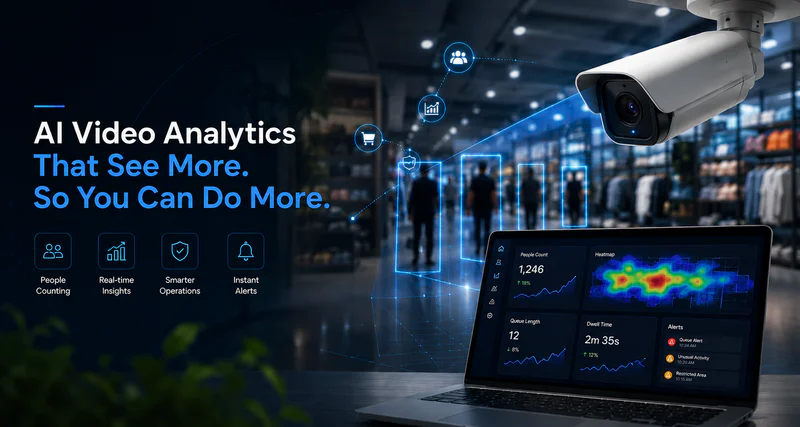
Businesses have cameras everywhere.
Retail stores, manufacturing facilities, warehouses and other commercial environments rely on CCTV cameras to monitor people, assets, vehicles and operations. But there is a fundamental limitation: cameras can record what happened without necessarily telling you what is happening right now.
When a security team needs to manually review hours of footage to understand an incident, identify unusual activity or investigate an operational problem, valuable time is already lost.
This is where AI video analytics solutions can make a difference.
Instead of treating CCTV as simply a recording system, video analytics adds an intelligence layer that can interpret camera feeds, identify defined events and convert visual information into structured, actionable insights.
StorePulse is an AI video analytics platform designed to work with existing camera infrastructure. It adds intelligence to your CCTV/VMS environment, helping businesses move from passive video monitoring towards real-time visibility and data-driven decision-making.
From people counting and queue management to vehicle detection, staff monitoring and smoke and fire detection, StorePulse brings multiple analytics capabilities together on one platform.
In this guide, we explore how StorePulse's video analytics solutions work, their key benefits, real-time monitoring capabilities, loss-prevention applications and use cases across industries.
What Are Video Analytics Solutions?
Video analytics solutions use artificial intelligence and computer vision to analyse video feeds and identify specific people, objects, movements or events.
Traditional CCTV primarily answers a question such as:
"What happened?"
AI-powered video analytics can help answer more operational questions:
How many people entered the location?
How long did customers remain in a particular zone?
Is a queue becoming too long?
How many vehicles entered an area?
Are staff members present where they should be?
How many boxes or bags moved through a particular area?
Is smoke or fire detected?
Has activity occurred in a monitored or restricted zone?
This changes the role of surveillance from a system that primarily stores footage into a source of structured business intelligence.
The global video analytics market is also expanding rapidly. Mordor Intelligence estimates the market at $15.04 billion in 2026, with projections reaching $33.74 billion by 2030 at a 22.18% CAGR.
For organisations already operating extensive CCTV infrastructure, the opportunity is not necessarily about adding more cameras. It is about extracting more value from the cameras they already have.
How StorePulse Works
StorePulse is designed as an AI video analytics layer that works alongside an organisation's existing CCTV/VMS environment.
The basic workflow can be understood in four stages:
Video Feed → AI Detection → Structured Data & Metadata → Dashboard + Real-Time Alerts
1. Video feed
Existing camera infrastructure captures video across the locations being monitored.
2. AI detection
StorePulse applies AI models to the available video feeds to identify people, objects and defined events.
3. Structured data
Instead of requiring teams to continuously watch raw footage, relevant information can be converted into structured data and metadata.
4. Dashboard and alerts
The resulting information can be presented through dashboards and real-time alerts, helping teams respond to events and understand operational patterns.
This is an important distinction.
StorePulse is not designed to replace your VMS. It complements the existing video management system by adding an AI analytics layer on top of camera infrastructure.
That means organisations can think about video analytics as an extension of the value of their existing surveillance environment rather than automatically treating it as a complete replacement for their current video management system.
What Can StorePulse Detect and Monitor?
One of the key advantages of StorePulse is that multiple capabilities are brought together as modules within a single platform.
Depending on the use case, StorePulse can support analytics such as:
People Counting and Footfall Analytics
People counting can help organisations understand how many people enter or move through a particular location.
For businesses with physical spaces, this information can provide useful operational context. Footfall data can support decisions around staffing, space utilisation and customer movement.
Zone Heatmaps and Dwell Time
Not every part of a location receives the same amount of attention.
Heatmaps can help businesses understand where people spend time, while dwell-time insights can provide additional context around movement and engagement within monitored areas.
For example, businesses can use this information to identify high-traffic zones or understand which areas receive less activity.
Queue Management
Long queues can affect customer experience and operational efficiency.
StorePulse's queue management capability can help organisations identify queue build-up and monitor waiting conditions through video analytics.
Because this information can be generated from camera feeds, teams can gain visibility without relying exclusively on manual observation.
Box, Sack and Bag Counting
Manufacturing and logistics environments often need to track physical items moving through operational areas.
StorePulse supports box, sack and bag counting, providing an AI-based way to monitor these objects through camera feeds.
Vehicle Detection
Vehicle detection can help organisations monitor vehicle activity within relevant areas.
This can be particularly useful in manufacturing and other environments where vehicle movement is an important part of day-to-day operations.
Staff Monitoring
StorePulse can support staff monitoring through video analytics, helping businesses gain visibility into activity across monitored areas.
Seat Occupancy
Seat occupancy analytics can help organisations understand whether designated seating areas are occupied and how space is being utilised.
Smoke and Fire Detection
Smoke and fire detection adds another layer of safety monitoring to video analytics.
In environments where early detection matters, real-time identification can be particularly valuable because the speed of response can influence the outcome of an incident.
Key Benefits of Video Analytics
The benefits of video analytics extend beyond security.
When camera feeds are converted into structured, actionable information, organisations can use the same infrastructure to improve security, operations and decision-making.
1. Enhanced Security and Faster Response
Traditional surveillance often depends on someone noticing an incident or reviewing footage after it occurs.
Real-time video analytics can change this approach by identifying defined events as they happen and generating alerts.
For example, an organisation may benefit from faster awareness of unauthorised activity, unusual events or smoke and fire detection.
The result is a shift from after-the-fact investigation to more proactive monitoring.
2. More Efficient Monitoring
Continuously watching multiple CCTV feeds requires significant human attention.
AI video analytics can automate the monitoring of specific events and conditions, allowing security and operations teams to focus their attention where it is needed most.
This does not necessarily mean removing human oversight.
Instead, it can help teams spend less time watching screens for something to happen and more time responding to meaningful alerts and insights.
3. Data-Driven Operational Decisions
Video analytics can turn visual activity into data.
Footfall, people counting, heatmaps and dwell-time information can help businesses understand how their physical spaces are being used.
That information can support decisions around:
Staffing
Store or facility layouts
Customer movement
Queue management
Space utilisation
Operational processes
Instead of relying entirely on assumptions, decision-makers can use data generated from real-world activity.
4. One Platform Across Multiple Use Cases
Another benefit is consolidation.
Instead of deploying a separate point solution for every surveillance requirement, StorePulse brings multiple analytics modules together within one platform.
This makes the platform relevant across different business environments and use cases.
5. Faster Investigations
When an incident occurs, security teams often need to search through large amounts of recorded footage.
Structured video analytics data can make investigations more targeted by providing event-based information rather than requiring teams to manually scrub through hours of raw video.
This can help reduce the time required to identify relevant footage and understand what happened.
Video Analytics and Loss Prevention
Loss prevention is one of the most important applications of intelligent video analytics, particularly in retail and other environments where unauthorised activity can directly affect revenue.
The video analytics loss prevention benefits come from combining surveillance with automated detection.
Instead of relying only on footage review after an incident, organisations can use relevant detection capabilities to identify unusual behaviour or unauthorised activity as it happens.
The scale of the problem makes this particularly important for retailers.
According to the National Retail Federation's 2023 National Retail Security Survey, retail shrink represented $112.1 billion in losses in 2022, equivalent to an average shrink rate of 1.6%.
AI video analytics does not eliminate every source of shrink or loss. However, it can provide security and loss-prevention teams with another layer of visibility into what is happening across monitored locations.
With StorePulse, relevant analytics can support loss-prevention workflows by helping identify activity that warrants attention, rather than relying entirely on manual footage review.
Importantly, StorePulse-specific percentages for shrink reduction or ROI should only be quoted when supported by a verified customer case study or product data.
What Does Real-Time Video Analytics Mean?
Real time video analytics means that video feeds can be analysed as activity occurs, allowing relevant information to be surfaced without waiting for a manual review of recorded footage.
Speed matters because some events become more difficult to address once they have already happened.
Consider queue management.
A queue that is manageable at one point can become a customer-experience problem minutes later.
Similarly, a smoke or fire event requires immediate awareness rather than a report generated hours later.
Unauthorised entry into a monitored area is another situation where the value of information depends heavily on how quickly it reaches the relevant team.
StorePulse's real-time analytics approach is therefore focused on connecting video feeds with detection, dashboards and alerts so that businesses can gain visibility into events as they happen.
Video Analytics Integration Capabilities
One of the biggest questions businesses have when considering AI video analytics is:
"Do we need to replace our existing CCTV infrastructure?"
StorePulse is designed to work with existing camera infrastructure, subject to the applicable compatibility requirements.
This approach can make AI analytics more practical for organisations that have already invested in CCTV and video management systems.
Rather than positioning StorePulse as a VMS replacement, it works as an analytics layer that complements the existing video management environment.
This distinction matters because a business may already have cameras, recording infrastructure and established security workflows.
Adding analytics can allow that infrastructure to become more intelligent without requiring the organisation to rethink its entire surveillance architecture.
The exact scope of camera compatibility and any additional system integrations should be confirmed with the StorePulse product team before implementation.
StorePulse Across Industries
StorePulse is positioned as an all-industries AI video analytics platform, rather than a solution designed exclusively for retail.
Its confirmed use cases include retail and manufacturing, with different analytics modules addressing different operational requirements.
StorePulse for Retail
Retail businesses can use video analytics to gain greater visibility into physical customer environments.
Relevant applications include:
Footfall and people counting
Queue management
Zone analytics
Dwell-time insights
Loss prevention
For retailers, the value of video analytics lies in connecting security and operational visibility.
The same camera infrastructure can provide information that helps teams understand customer movement while also supporting security and loss-prevention activities.
StorePulse for Manufacturing
Manufacturing environments have a different set of requirements.
StorePulse supports manufacturing-specific use cases including:
Box, sack and bag counting
Vehicle detection
Staff monitoring
Seat occupancy
Smoke and fire detection
These capabilities can help organisations gain greater visibility across operational areas where manual monitoring can be difficult to scale.
For manufacturing businesses, AI video analytics can therefore extend beyond traditional security and become part of a broader operational monitoring strategy.
Why Choose StorePulse for AI Video Analytics?
The value of an AI video analytics platform depends not only on individual detection capabilities but also on how those capabilities fit into an organisation's existing environment.
StorePulse brings several elements together:
Built Around Existing Camera Infrastructure
StorePulse is designed to work with existing camera infrastructure, helping businesses add intelligence to their surveillance environment.
Multiple Analytics Modules
People counting, queue management, vehicle detection, object counting, staff monitoring, occupancy and smoke/fire detection can be addressed through modules within the same platform.
All-Industry Positioning
StorePulse is not limited to a single sector. Confirmed applications span retail and manufacturing, with the platform designed for broader industry use.
Complements Existing VMS
StorePulse is an analytics layer rather than a direct VMS replacement, allowing businesses to add AI capabilities to an existing video management environment.
Backed by an Established Technology Company
StorePulse is backed by Transline Technologies, which was founded in 2001.
This provides an established technology-company foundation for a product focused on the evolving requirements of AI-powered video analytics.
The Future of Video Analytics
The role of CCTV is changing.
For years, the primary purpose of surveillance cameras was to record what happened. With AI and computer vision, organisations can increasingly use those same visual feeds to understand what is happening and extract structured information from them.
This is reflected in the broader growth of the video analytics market.
Mordor Intelligence estimates that the market will grow from $15.04 billion in 2026 to $33.74 billion by 2030, representing a 22.18% CAGR.
Independent research also points to the business case for video analytics. An Omdia study of 140 end users across North America and Europe, commissioned by BriefCam, found that more than 85% of surveyed organisations achieved ROI from their video analytics solution within one year. The study identified areas including loss prevention, security costs and time spent on security tasks among the key impact areas.
These figures describe the wider video analytics market and should not be interpreted as performance claims for StorePulse.
For businesses, the broader message is clear: video analytics is moving beyond a purely security-focused application.
It is becoming a way to convert visual information into operational intelligence.
Conclusion: Make Your Cameras More Intelligent With StorePulse
Cameras can capture enormous amounts of information. The challenge is turning that information into something your teams can actually use.
AI video analytics solutions provide a way to bridge that gap.
StorePulse adds an intelligence layer to existing camera infrastructure, helping organisations move from passive video recording towards real-time monitoring, structured data and actionable insights.
From people counting and queue management in retail to box and bag counting, vehicle detection, staff monitoring and smoke and fire detection in manufacturing, StorePulse brings multiple analytics capabilities together on one platform.
The result is a more intelligent approach to surveillance, one that can support security, loss prevention, operational efficiency and data-driven decision-making.
If your organisation already has cameras but wants to get more value from them, the next step is to explore what AI video analytics can do for your environment.
Book a StorePulse demo and discover how your existing camera infrastructure can become a source of real-time intelligence.